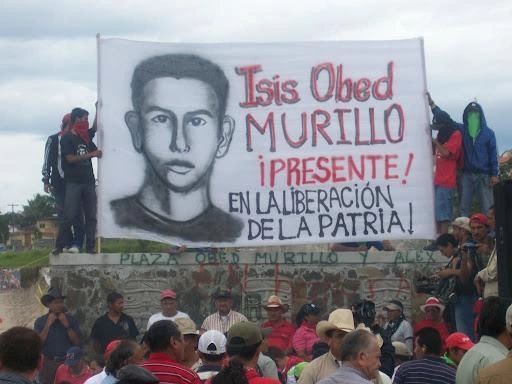
It was July 5, 2009. A crowd of hundreds of thousands had gathered at Tegucigalpa’s Toncontín Airport, hoping to witness an act that would defy the narrative of the coup d’état that had ousted Manuel Zelaya just weeks before. Zelaya’s plane, accompanied by other presidents and political allies, attempted to land at the airport, but the Armed Forces had positioned heavy vehicles on the runway to block it. As the plane circled and eventually departed, frustration among the crowd grew. By late afternoon, the people attempted to storm the runway to clear it and allow Zelaya to land. The Armed Forces responded with gunfire and tear gas. While many live rounds were fired and snipers were stationed around the perimeter, it is important to note that these were not aimed directly at the crowd. Had they been, the casualties would have been counted in dozens. Amid the chaos, a bullet struck the back of the head of 19-year-old Isis Obed Murillo, transforming him into an immortal symbol of Honduran resistance.
Almost 16 years later, the name Romeo Vásquez Velásquez, the general who led the Armed Forces during that coup, has returned to the headlines. Detained alongside other high-ranking officials, he faces accusations of human rights violations, extrajudicial executions, and brutal repression in the years following the coup. This arrest, belated but significant, marks a milestone in Honduras’s history, a country that for decades has oscillated between impunity and the pursuit of justice.
In previous interviews, Vásquez Velásquez claimed to have acted in defense of democracy, justifying the coup as a measure to halt the advance of 21st-century socialism promoted by Zelaya. He categorically denied any responsibility for the death of Isis Obed, attributing it to “short weapons” used by infiltrators—a claim that never convinced the victims’ families or human rights defenders. In 2018, during an interview I conducted with him at his office, he declared, “My honor will not be tarnished,” denouncing what he perceived as a politically orchestrated vendetta by the Zelaya camp.
But facts are stubborn. Murillo’s murder and the violence unleashed at Toncontín that July 5 were not isolated incidents. They were part of a systematic repression strategy that included arbitrary detentions, torture, and a state of siege that paralyzed the country for weeks. In 2017, I interviewed the family of Isis Obed, who vividly described the pain of losing a son and the despair of confronting a system that denied them justice. For them, Isis Obed is not just a symbol; he is a constant reminder that the fight for memory and truth is far from over.
The arrest of Vásquez Velásquez also highlights the failures and omissions of the Guaymuras Dialogue and the Cartagena Agreement, two attempts at reconciliation that prioritized Honduras’s return to the international community over the victims’ demands. Although these agreements—boycotted by both sides of the crisis—led to the creation of the Truth and Reconciliation Commission, efforts to investigate and prosecute human rights violations fell short. Isis Obed’s case never reached a court of law; the crime scene was immediately contaminated by the crowd that gathered around the bloodstain, singing the national anthem. The forensic autopsy was “reconstructed,” according to the prosecutor, after the original report disappeared from the Public Ministry’s case file. Meanwhile, those materially and intellectually responsible remained in positions of power.
In this context, the recent arrest is both progress and a reminder of the debts still owed. Vásquez Velásquez’s capture comes at a politically charged moment. Honduras is now led by Xiomara Castro, Zelaya’s wife and the country’s first female president, amid a polarized discourse where the coup’s narrative continues to divide society.
The general’s defense, as expected, has denounced the charges as a “political vendetta.” They argue that after more than a decade out of power, these accusations aim to discredit him and divert attention from current issues. This morning, presidential advisor Enrique Flores Lanza—a self-declared victim of the coup, granted amnesty at the start of Castro’s administration, and flagged in the Engel List by the U.S. Department of State for undermining the country’s democratic institutions—announced that the prosecutor’s office would expand the indictment against General Vásquez, adding more victims from the 2009 repression. It is important to recognize in this context that Honduran institutions have long been marked by cycles of impunity and lack of independence. The pursuit of justice has been consistently delayed by those in power, leading the Honduran population to lose faith in a judicial system that often seems to serve the interests of those in charge, whether to accuse or to conceal accusations. This forces us to ask: Is this arrest a sign of justice or a political maneuver by the current government?
What is clear is that Vásquez Velásquez’s arrest is not just about him but about what he represents—a coup d’état that remains a bleeding wound in society. His capture reopens the debate about the relationship between the Armed Forces and civilian power in a context where the current leadership is accused of aligning with the Zelaya political agenda. The memory of the coup’s victims and the commitment to human rights must be our guiding principles, as well as the establishment of an independent and professional prosecutorial system. If the Honduran judicial system can handle this case transparently and rigorously, it could set a historic precedent. But if it fails and raises doubts about political motives behind the case, the arrest will be remembered as just another symbolic gesture in a long history of unfulfilled promises—or worse, as evidence of the abuse of the justice system for political ends.
Meanwhile, the families of victims like Isis Obed Murillo continue to wait. They are hopeful. They seek justice, but they also want to ensure that the sacrifice of their loved ones is not lost to oblivion. I recall the words of his mother: “Isis died for democracy, but what have we done for it?” That question, laden with pain and reflection, resonates today more strongly than ever—not only in Honduras but also in those places where democracy wavers, perpetually threatened by authoritarianism and indifference.tened by authoritarianism and indifference.